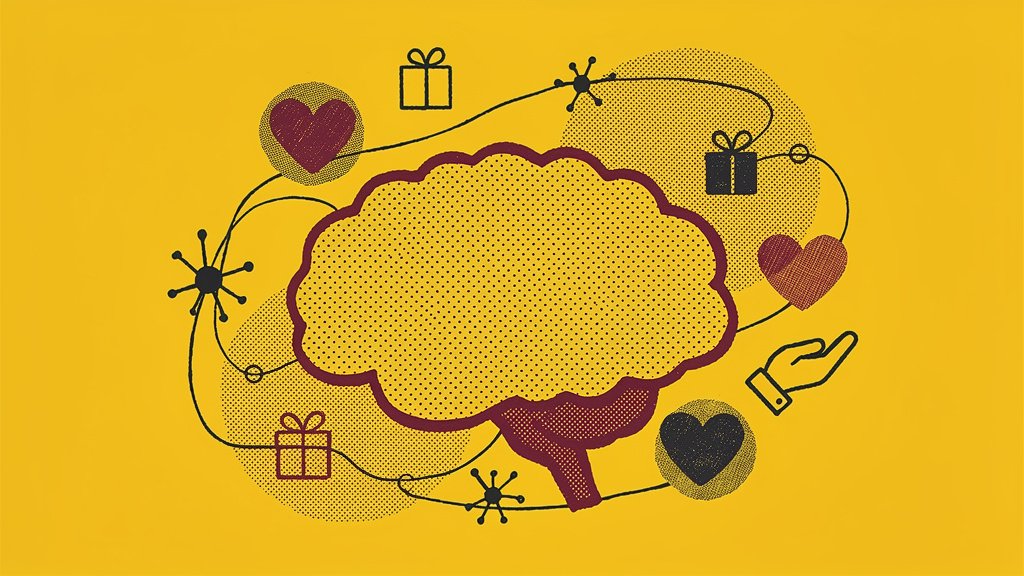
Look, here’s the thing: your donors’ brains are already wired to be generous. The question is whether you’re tapping into that natural wiring or working against it.
There’s this fascinating molecule called oxytocin (nicknamed “The Empathy Molecule,” which sounds a bit sci-fi but stick with us here) that’s basically the chemical driver of trust and generosity in our brains. When someone hears a vulnerable, character-driven story, their brain produces an empathy response that directly increases their likelihood to give. This isn’t about manipulation. It’s about understanding how authentic human connection works at a neurological level and crafting appeals that honor both your mission and your donors’ genuine desire to make a difference.
The Oxytocin Effect: Why Vulnerability Wins
So what actually happens in the brain when someone feels empathy? Oxytocin surges during those empathetic moments, directly fueling generosity toward complete strangers. In one groundbreaking study, just watching emotional video clips raised participants’ oxytocin levels by 47% from baseline (PubMed study). And here’s where it gets interesting: that spike led people to make way more generous offers in economic games. Women showed even stronger responses, which tells us gender plays a real role in how this “cuddle hormone” influences giving.
This hormone enhances trust and social bonding in ways that mimic our closest personal relationships. When you share a single beneficiary’s story rather than drowning donors in statistics, you’re activating oxytocin pathways that increase donations beyond what logical appeals alone could ever achieve. And honestly? This explains why personalized, emotional narratives consistently crush statistics in fundraising campaigns. Your donors aren’t calculators. They’re human beings whose brains light up when they connect with another person’s story.
Protip: Try starting your appeals with a 30-second video of a beneficiary’s raw emotion to spike those oxytocin levels. Test this via A/B testing in email campaigns, and you might see a 20-30% lift in response rates.
Common Challenges We See Daily
Before nonprofits discover the neuroscience of giving, we notice some predictable patterns that limit their growth:
The statistics trap. You’ve probably done this (we all have): sent appeals loaded with numbers about thousands served, thinking scale impresses donors. But opens stay low, conversions lower. The brain science is actually backwards here. One relatable person beats a thousand data points every single time.
Generic thank-you syndrome. When donors get vague “your gift makes a difference” messages, those fail to trigger the dopamine rewards their brains are craving. Without specific impact feedback, there’s no neural association between your organization and the warm glow that drives repeat giving.
The rational-only approach. Mission-focused leaders often craft appeals emphasizing program efficiency and overhead ratios, then wonder why engagement flatlines. Thing is, they’re speaking to the prefrontal cortex while ignoring the limbic system, which is where giving decisions actually happen.
Segment blindness. Treating all donors identically despite clear behavioral differences is like using the same key for every lock. Some folks respond to stories, others to data. Without matching neurobiological triggers to donor types, campaigns achieve mediocre results across the board.
Your Brain on Generosity: The Reward Circuit
Generous acts activate the brain’s ventral striatum, creating this pleasurable “warm glow” that reinforces giving. fMRI studies reveal that this reward response actually mirrors what happens when you eat chocolate or win money, but here’s the kicker: it lasts longer for prosocial choices (NIH research).
The temporoparietal junction (TPJ, for those keeping track at home) is a brain region involved in perspective-taking and empathy. It shows increased connectivity with reward areas and predicts happiness gains from generosity. When donors commit to give, TPJ activity spikes, linking empathy to sustained joy and increasing the likelihood they’ll give again.
And here’s where it gets interesting for fundraisers: donating time engages reward and mentalizing regions more intensely than donating money alone. That suggests hybrid asks combining volunteer opportunities with financial gifts may maximize the neural payoff.
| Brain Region | Role in Giving | Fundraising Application |
|---|---|---|
| Ventral Striatum | Pleasure/reward processing | Post-donation thank-yous emphasizing specific impact |
| Temporoparietal Junction (TPJ) | Empathy and perspective-taking | Stories prompting “put yourself in their shoes” |
| Prefrontal Cortex | Decision-making and evaluation | Clear ROI framing to override default selfishness |
Dopamine: The Motivation Molecule
Dopamine release from giving creates this addiction-like motivation for future donations. Acts of kindness trigger this neurotransmitter in reward centers, which means your nonprofit gets associated with positive emotions that donors unconsciously seek to repeat.
Feedback loops amplify this effect like crazy. Detailed impact reports sustain those dopamine highs, boosting donor retention. Vague thanks yield minimal neurological reward, while specifics like “Your $50 fed 10 families this week” actually rewire brains for loyalty.
Unconventional approach: What if you gamified your appeals with progress bars showing collective impact? This mirrors the dopamine loops that make video games addictive (yes, we’re comparing your nonprofit to Candy Crush, and we’re not sorry). It could potentially increase average gift sizes by tapping into reward anticipation rather than just reward completion.
Protip: Segment your donor list by past behavior to identify story responders versus data lovers. Rotate neuroscience-backed triggers quarterly to prevent habituation, which can sustain 10-15% higher lifetime value.
AI Prompt: Generate Neuro-Optimized Fundraising Appeals
Ready to apply neuroscience to your next campaign? Copy and paste this prompt into ChatGPT, Claude, Gemini, or your preferred AI tool:
Create a fundraising email appeal optimized for neurobiological response that includes: 1) An opening story featuring [BENEFICIARY NAME/TYPE] experiencing vulnerability related to [SPECIFIC CHALLENGE], 2) Mirror language using 'we' and 'you' to activate empathy centers, 3) Exact impact quantification showing how [DONATION AMOUNT] produces [SPECIFIC MEASURABLE OUTCOME], and 4) An urgency close emphasizing what's at stake if the donor doesn't act. Target audience: [DONOR SEGMENT]. Keep total length under 300 words.In your daily fundraising work, consider solutions like Funraise that have AI components built directly into the platform where you’re executing tasks, providing full operational context rather than requiring you to switch between tools.
Character-Driven Narratives: The 80% Solution
Character-driven narratives of struggle release oxytocin, mediating 80%+ generosity spikes. In one study, oxytocin infusions made participants 80% more generous in trust games, independent of pure altruism (NIH study). The chemical change was direct and measurable. Yeah, you read that right: 80%.
Vulnerability in storytelling fosters emotional identification that overwrites selfish motives through those TPJ-striatum neural links we mentioned earlier. Studies consistently confirm that empathy for strangers cultivated through stories predicts variation in interpersonal giving behavior.
“When donors see themselves in your beneficiary’s story, they’re not just giving to a cause. They’re investing in the version of the world they want to live in, and that emotional connection drives sustainable revenue far beyond any single campaign.”
Funraise CEO Justin Wheeler
The formula’s pretty straightforward: introduce a specific person, share their vulnerable moment, show the transformation your organization enables, and connect the donor directly to that outcome. This isn’t marketing manipulation. It’s honoring how human brains naturally process meaning and connection.
Multiple Neurobiological Levers: The Integrated Approach
The most sophisticated fundraising appeals don’t rely on just one neurological pathway. Combining oxytocin, dopamine, and cognitive control creates compounded effects. Generosity recruits the dorsolateral prefrontal cortex for evaluation, the anterior cingulate cortex for emotional processing, and the ventromedial prefrontal cortex for valuation. (Okay, we’re getting a li’l neuroscience-heavy here, but bear with us.)
Different donor types respond to different triggers:
- Empathy-leading donors (heart-driven): Thrive on personal stories and oxytocin boosts,
- Analysis-leading donors (head-driven): Respond to TPJ-driven perspective-taking combined with data,
- Social proof-oriented donors: Activate oxytocin through perceived community trust.
This diversified approach matches brain mechanisms to donor segments, raising overall campaign yields beyond what one-size-fits-all messaging can achieve.
Real-World Impact: The Numbers Behind the Neuroscience
U.S. charitable giving hit $592.50 billion in 2024, up 6.3% from the previous year (3.3% inflation-adjusted) (Giving USA 2025). Individuals drove the bulk of that, contributing $392.45 billion, which represents 8.2% growth. This reflects enduring generosity even amid economic pressures, and organizations that understand donor psychology are capturing disproportionate shares.
In our experience, Funraise users grow online donations 73% year-over-year (three times the industry average), with 52% recurring revenue growth and 50% donation form conversion rates that outpace benchmarks (Funraise growth statistics). While platform features matter, we’ve found these results likely stem from seamless experiences that reduce friction when neurological giving impulses strike.
When donors feel that oxytocin surge from your story, you’ve got seconds to capitalize before rational override kicks in. Clunky donation forms kill conversions that neuroscience worked hard to create.
Crafting Your Neuro-Optimized Appeal
Here’s your roadmap for appeals that trigger specific chemical responses:
Step 1: Hook with vulnerability. Open with 1-2 sentences of beneficiary story that creates immediate emotional connection and oxytocin release.
Step 2: Build connection. Use “we” and mirror language that activates TPJ perspective-taking, making donors feel part of the solution rather than outside observers.
Step 3: Quantify the warm glow. Show exact impact to trigger dopamine reward anticipation. Not just “you’ll help families” but “you’ll provide 3 weeks of meals for the Martinez family.”
Step 4: Close with urgency. Employ loss aversion framing that engages prefrontal cortex override of default inaction. What happens if they don’t give?
Test these elements through multivariate campaigns and iterate based on open, click, and conversion data. The beauty of brain science? These responses are measurable and improvable.
The Ethical Dimension
Hm. Before we wrap this up, let’s talk ethics for a second. Leverage brain science responsibly by prioritizing genuine impact transparency over manipulation. Overpromising erodes trust, which reduces oxytocin response in future interactions and damages long-term donor relationships.
Focus on mutual benefit: donors receive authentic neural rewards through the warm glow of meaningful contribution, while your cause advances its mission. This isn’t zero-sum. When you help donors’ brains experience the joy of generosity while delivering real impact, you build loyalists whose giving pathways strengthen with each interaction.
The neuroscience of giving isn’t a trick. It’s understanding how humans are designed to connect, empathize, and find meaning through helping others. Honor that design in your fundraising, and you’ll raise more money while building a community of supporters whose brains are literally wired to keep giving.
Ready to test these neuroscience-backed approaches? Funraise offers a free tier with no commitments, allowing you to experiment with optimized donation forms, storytelling tools, and analytics that help you understand which triggers resonate with your specific donor base. Start for free and discover what happens when brain science meets fundraising strategy.
About the Author

1) Why Most Nonprofit Strategies Fail: The Glass-Chewing Truth
You've sat through dozens of strategy meetings, right? Whiteboards covered in ambitious goals, spreadsheets showing exponential growth curves, slides promising transformational impact. Fast forward six months and, well, nothing's really changed. Revenue's stuck, your team's exhausted, and the mission feels like it's drifting. Here's the thing: most nonprofit strategies don't fail because of bad planning.…
2) Closing the Nonprofit Technology Gap: Stop Duct-Taping Your Mission
Your mission deserves better than patchwork tech held together with digital duct tape and prayers. Look, here's the thing. With over 1.4 million nonprofits in the US, most operating under $1M in annual revenue, the "technology gap" isn't just annoying. It's a systemic barrier that caps your impact before you even begin. In this guide,…
3) Modern Nonprofit Board Governance: Moving Boards to Mission Growth
Most nonprofit boards live in a state of financial anxiety, spending way more time worrying about budget cuts than imagining what transformational impact could look like. Here's the thing: board members are naturally cautious (it's basically written into their job description), but that defensiveness can freeze the very growth that'd make your mission stronger. So…