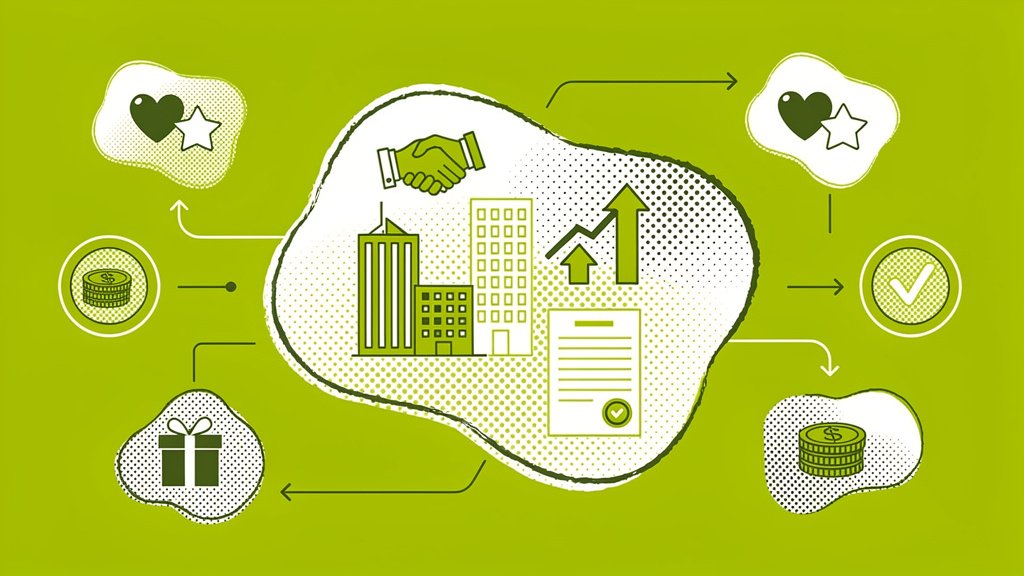
Look, if you’re leaving corporate donations on the table, you’re not alone. We’ve worked with thousands of nonprofits who didn’t realize just how much potential sits in this revenue stream. U.S. corporations contributed $44.40 billion to charities in 2024, marking a 9.1% increase from the prior year (Giving USA). But here’s the thing: most organizations struggle to tap into it because they’re winging it without a real system.
This guide walks you through everything you need to actually secure corporate donations, matching gifts, grants, and in-kind contributions. No fluff, just the practical steps that work. Many companies are also looking for ways to support their favorite causes through innovative funding strategies. One effective approach is to set up automatic donations for nonprofits, ensuring a consistent flow of support for the organizations that matter most. Additionally, creating partnerships with these nonprofits can enhance visibility and engagement for both parties. In addition to these strategies, understanding the tax benefits of charitable contributions can incentivize more businesses to engage in philanthropy. By showcasing how corporate giving not only aids communities but also offers financial advantages, companies can be motivated to increase their support. This dual benefit creates a win-win situation where both nonprofits and businesses thrive together. To facilitate these partnerships, developing a non profit donation receipt template can streamline the process for both the donor and the recipient organization. This template not only provides clarity and documentation for contributions but also helps maintain transparency and trust. Ensuring that all needed information is included will encourage more businesses to get involved and make a positive impact.
Why Corporate Partnerships Matter Beyond Cash
Before we jump into tactics, let’s get clear on what companies actually offer. It’s not just checks. You’ve got matching gifts (where employers double what their people donate), volunteer grants (literal cash for volunteer hours), project-specific grants, multi-year pledges, in-kind products, and pro bono services. Each one serves different needs.
The matching gift opportunity alone? Staggering. 78% of donors don’t even know their employers match gifts, leaving an estimated $4-7 billion unclaimed every year (Double the Donation). Companies like GE matched $18 million in 2022, yet most nonprofits never bother asking donors to check if they’re eligible.
In our experience: Integrate matching gift fields right into your donation forms. When donors see “Your company may double this gift” at checkout, conversion jumps. Funraise users report 50% donation conversion rates partly because matching prompts are baked into the giving experience (Funraise Growth Statistics).
Step 1: Build Your Corporate Prospect List Strategically
Skip the spray-and-pray approach. Start by mining your existing donor database for employer information. Your supporters’ companies are warm prospects because employee advocacy dramatically increases your approval odds.
Research corporate giving programs through company CSR pages and annual reports, Foundation Directory databases, local chamber of commerce listings, and industry-specific giving roundups.
Prioritize targets based on alignment:
| Company Type | Best Fit For | Typical Gift Range | Access Point |
|---|---|---|---|
| Local businesses | Community programs, events | $500-$5,000 in-kind or cash | Direct outreach, personal intro |
| Regional banks | Financial literacy, housing | $5,000-$25,000 grants | Community relations departments |
| Tech giants | Education, digital equity | $10,000+ plus software | Online portals (Google.org) |
| Consumer brands | Cause marketing campaigns | Product donations + cash | Brand partnership teams |
Focus on companies offering matching gifts at 1:1 ratios (91% of programs) or volunteer grants. Fun fact: 40% of Fortune 500 companies offer volunteer grants, typically $8-15 per hour volunteered (Double the Donation).
Common Challenges We See Every Day
Working with thousands of nonprofits through Funraise, we’ve spotted some predictable stumbling blocks.
The “We Don’t Know Who Works Where” Problem: You’re collecting donations but never capturing employer data. One client discovered 23% of their donors worked at matching-eligible companies only after adding a simple employer field to their forms. Ouch.
The Manual Matching Nightmare: Hours spent researching individual companies’ matching policies, creating spreadsheets, emailing donors instructions. By the time you follow up, the donor’s moved on.
The One-Size-Fits-All Pitch: Generic sponsorship decks sent to pharmaceutical companies and bakeries alike. Corporate decision-makers delete these instantly.
These challenges disappear with proper systems in place, which is honestly why tools like Funraise exist. We’re talking about automating matching gift discovery, streamlining donor communications, and personalizing outreach at scale.
Step 2: Master the Corporate Giving Landscape
Understanding how companies structure philanthropy saves you tons of wasted effort. Corporate giving typically flows through four channels.
Corporate Foundations: Separate entities with formal grant cycles (think Coca-Cola Foundation community grants). These require detailed applications and 501(c)(3) verification.
Direct Corporate Giving: Marketing or community relations budgets for sponsorships and local partnerships. Often more flexible but smaller amounts.
Employee Giving Programs: Matching gifts and volunteer grants that activate when employees engage with your nonprofit. 85% of top matching gift companies also offer volunteer grants (Double the Donation), turning your volunteers’ time into unrestricted revenue.
In-Kind Contributions: Donated products, services, or pro bono expertise. A tech company might donate laptops while a law firm offers free legal counsel.
The most successful nonprofits layer these approaches. You might secure a $10,000 grant from a corporate foundation, activate $15,000 in employee matching gifts, and receive $5,000 worth of volunteer grants from the same company.
Step 3: Craft Irresistible Corporate Proposals
Generic asks get generic results. Your proposal must align with the company’s specific CSR goals while quantifying impact.
Structure your pitch around these elements:
The Values Hook: Open by demonstrating you’ve done your homework. “Your 2024 sustainability report emphasizes water conservation. Our watershed restoration program directly supports that mission.”
Impact Metrics: Corporations think in numbers. Instead of “we help families,” try “Your $15,000 investment provides 500 families with six months of nutritious meals, reducing childhood ER visits by 34% based on our outcome data.”
ROI for the Company: Employee engagement matters to HR departments. “Our corporate volunteers report 40% higher job satisfaction scores” gives decision-makers internal justification.
Tiered Options: Offer multiple entry points. Bronze ($2,500) gets logo recognition and social media mentions. Silver ($5,000) adds an event booth and quarterly impact reports. Gold ($10,000) includes naming rights, employee volunteer days, and co-branded campaigns. Platinum ($25,000+) becomes a strategic partnership with C-suite engagement.
Keep proposals to 2-3 pages for initial outreach. Save the 20-page detailed proposal for later conversations.
Protip: For corporate portals with strict deadlines (like Google’s ad grant program), submit applications early in the cycle. Competition intensifies near deadlines, and early submissions often get more thorough reviews.
AI-Powered Proposal Generator Prompt
Ready to streamline your corporate outreach? Copy this prompt into ChatGPT, Claude, Gemini, or Perplexity to generate customized corporate sponsorship proposals:
Create a compelling corporate sponsorship proposal for [COMPANY_NAME] targeting their [CSR_FOCUS_AREA] priorities. Our nonprofit [YOUR_NONPROFIT_NAME] focuses on [YOUR_MISSION_AREA]. Include: 1) An opening paragraph connecting their corporate values to our mission, 2) Three quantified impact statements, 3) Tiered sponsorship options from $5,000-$25,000 with specific benefits at each level, 4) One employee engagement opportunity. Keep the tone professional but warm, and limit to 500 words.Variables to customize:
- [COMPANY_NAME],
- [CSR_FOCUS_AREA] (e.g., environmental sustainability, workforce development),
- [YOUR_NONPROFIT_NAME],
- [YOUR_MISSION_AREA].
While AI tools help draft initial outreach, daily fundraising work benefits from platforms like Funraise that embed AI directly into your operational context. We’re talking about understanding your donor data, campaign history, and organizational goals to provide truly contextual recommendations.
Step 4: Execute Multi-Channel Outreach
Cold applications to corporate portals yield 5-10% success rates. Warm introductions through employees or board members boost approval to 40-60%.
Your outreach sequence should look something like this:
Internal Network Activation (Week 1): Email donors who work at target companies. “Did you know [Company] might match your gift? Could you introduce us to your community relations contact?”
LinkedIn Research (Week 1-2): Identify CSR directors, community relations managers, or foundation officers. Engage with their content before reaching out.
Personalized Email (Week 2): Send customized pitches referencing specific company initiatives. Mention employee connections if you’ve got them.
Follow-Up (Week 4): If no response, send a brief check-in with one new piece of information like a recent impact story or upcoming event.
Phone Call (Week 6): For priority prospects, call with a specific question rather than a generic “checking in.”
For local businesses, in-person coffee meetings outperform digital outreach every time. Bring a one-page impact sheet and a specific ask.
“The most effective corporate partnerships aren’t transactional; they’re strategic relationships where both parties grow together. When you position your nonprofit as a partner in achieving their CSR goals rather than just another recipient, everything changes.”
Funraise CEO Justin Wheeler
Step 5: Activate and Maximize the Partnership
Approval is just the beginning. Proper activation determines whether a one-time gift becomes a multi-year partnership.
For matching gifts, make the process frictionless. Provide donors with pre-written matching gift request emails. Link directly to company matching portals in thank-you messages. Send quarterly reminders to recurring donors at matching-eligible companies.
Funraise users grew online revenue 73% year-over-year partly through seamless matching gift integration that prompts donors automatically (Funraise Growth Statistics).
For grants and sponsorships, deliver on promises immediately. Get logo placement done within 48 hours of agreement. Introduce corporate contacts to program staff. Schedule the first impact update before the check even clears.
Protip: Track volunteer hours meticulously if your corporate partner offers volunteer grants. 85% of top matching companies provide these grants, typically converting each volunteered hour into $8-15 in unrestricted funding (Double the Donation). That team of 10 employees who volunteered 40 hours could generate $3,200-$6,000 in additional funding.
Step 6: Steward for Long-Term Growth
Corporate giving retention follows the same principles as donor retention, yet nonprofits often neglect corporate stewardship. Don’t make that mistake.
Your stewardship calendar should hit these marks:
- 48 Hours Post-Gift: Personalized thank-you from your executive director,
- 30 Days: Impact photo and initial results,
- 90 Days: Detailed impact report with metrics,
- 6 Months: Invitation to site visit or program observation,
- Annual: Renewal proposal with expanded partnership options.
Use specific attribution. “Thanks to [Company]’s support, we served 347 additional clients this quarter.” Corporate sponsors need proof their investment mattered.
94% of major corporations plan to maintain or increase giving levels (BWF), making stewardship your growth engine. A company giving $10,000 annually could grow to $25,000 with proper cultivation.
Track everything in your CRM. Which industries respond best? What ask amounts optimize conversion? Which benefits drive renewals? Data transforms hunches into strategy.
Your Implementation Timeline
Don’t attempt everything simultaneously. Phase your approach like this:
Month 1: Audit existing donors for employer data, research 20 target companies, create proposal templates
Month 2: Launch employee network outreach, submit 5 portal applications, schedule 3 local business meetings
Month 3: Follow up on initial outreach, steward new corporate partners, refine messaging based on responses
Month 4+: Scale successful approaches, build multi-year partnerships, integrate matching gift prompts across all donor touchpoints
The corporate giving landscape offers unprecedented opportunity. With corporations contributing record amounts and 90% of Funraise donors choosing to cover processing fees (Funraise Trends) (increasing net revenue from corporate partnerships), the infrastructure for sustainable corporate fundraising exists.
So the question isn’t whether corporate partnerships can transform your funding model. It’s whether you’ll implement systematic processes to capture this revenue. Start with one step from this blueprint today. Your future budget will thank you.
Ready to implement corporate giving at scale? Funraise offers free plans for growing nonprofits with built-in matching gift tools, donor management, and AI-powered insights. Test the platform with no commitments at funraise.org and see why thousands of nonprofits choose Funraise to maximize corporate partnerships.
About the Author

Capital campaign pledge card: what to include so five-year pledges actually get paid
A five-year pledge is basically a promise stretched across sixty months of life. Kids graduate, budgets shift, priorities change, and somewhere in there, a commitment that felt rock-solid on signing day can start to wobble. If your capital campaign pledge card is just a name, a dollar amount, and a signature line, you're leaving way…
Capital campaign feasibility study: what it tests, who to interview and when you can skip it
Before you announce a $2 million building fund or float the idea of a $10 million endowment push, there's really one question that matters: will anyone actually give? A capital campaign feasibility study is how you find out, before you spend down donor goodwill and political capital on a campaign that wasn't quite ready for…
Endowment fundraising: how to ask for gifts that pay your nonprofit forever
Most of the asks you make this year fund… well, this year. Endowment asks are different animals entirely: they fund every year after that, forever. And that one distinction changes pretty much everything, how you frame the conversation, who gets invited into it, and what you're actually promising in return. If you're a nonprofit leader…