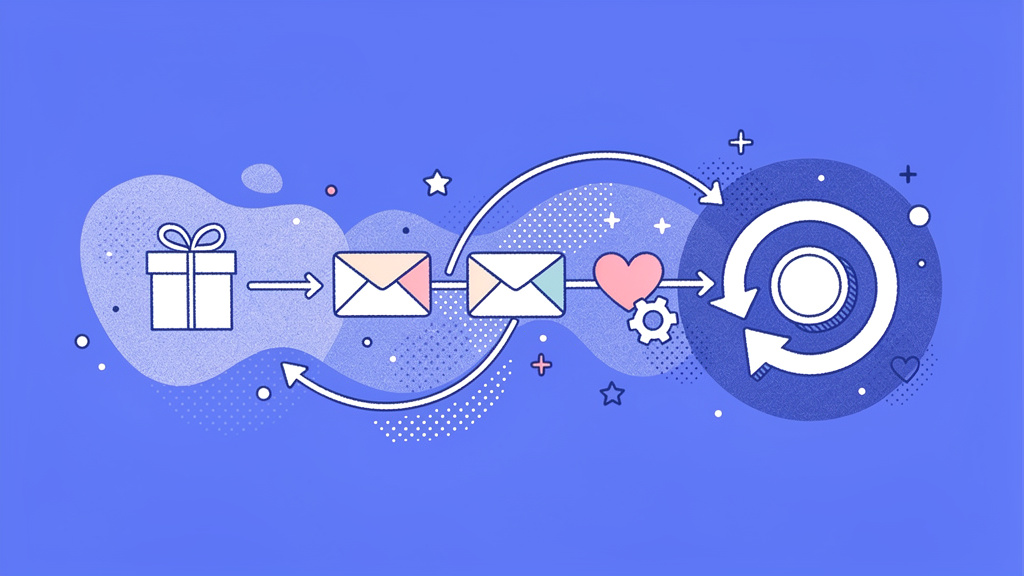
Most nonprofits throw a little party when that first donation lands. And then… nothing. No real follow-up system, no intentional next step, just a thank-you email and crossed fingers. Sound familiar? Here’s the thing: keeping a donor engaged after that first gift isn’t about working harder, it’s about working smarter with the right sequence in place at the right time.
In this post, we’re doing a deep dive into donor email automation, specifically how to build a journey that takes someone from “first-time giver” to “recurring supporter” without burning out your team. You’ll walk away with a five-stage email framework, real talk about what goes wrong, and even an AI prompt you can steal today.
Why the First 14 Days Are Everything
The window between a donor’s first gift and their second is where retention is won or lost. Recurring programs achieve over 80% retention after year one, far outpacing one-time gifts (Andar Software). But getting donors there requires deliberate onboarding, not a single thank-you email followed by silence.
First-time giver conversion depends on three psychological triggers: validation (did my gift matter?), connection (do I belong here?), and momentum (what’s my next step?). Your automated sequence needs to address all three before the 14-day mark. After that, the window closes fast.
The 5-Stage Automated Email Sequence
Map your automation to five key touchpoints. This isn’t about volume, it’s about precision.
| Stage | Trigger | Core Goal | Key Content |
|---|---|---|---|
| Decision | Immediately post-gift | Gratitude + receipt | Personalized thank-you, tax receipt, impact snapshot |
| Retention | Day 3 | Build emotional bond | Story of gift’s direct use, exclusive donor update (Media Cause) |
| Conversion | Day 7-14 | Propose recurring | One-button upgrade, monthly impact preview |
| Engagement | Month 1, no repeat gift | Re-engage or redirect | Survey, volunteer invite, peer story |
| Advocacy | 3+ gifts | Deepen loyalty | Behind-the-scenes content, milestone recognition |
Each stage should trigger automatically based on donor behavior, not calendar dates. Tools that sync donation data directly with email automation eliminate the manual list exports that kill timing and personalization.
Protip: Tag donors by gift size at the point of donation. Micro-donors ($1-$100) respond best to simple human stories, while larger donors engage more with data and organizational impact. Segmenting this way from the start costs nothing extra but dramatically improves conversion rates (Bloomerang).
Writing Emails That Actually Convert
Strong nonprofit email automation lives or dies on content. So what separates the emails donors open from the ones they delete?
- subject lines tied to personal impact: “Your Gift Changed Sarah’s Life, Here’s How” outperforms generic subject lines by connecting the reader’s action to a real outcome (Media Cause),
- one story, not a report: pick one beneficiary, one moment, one outcome. “Because of you, Marcus got his first stable housing in three years” beats a list of statistics every time,
- single, frictionless CTA: your Day 7-14 email should have exactly one ask: “Make This Monthly?” Pre-fill the amount based on their original gift. Reduce every click between curiosity and commitment,
- mobile-first formatting: more than half of email opens happen on phones. Short paragraphs, large buttons, and minimal images aren’t optional.
AI Prompt: Build Your Donor Email Sequence
Ready to draft your automated sequence faster? Copy and paste this prompt into ChatGPT, Claude, Gemini, or whichever AI tool you’re already using:
You are an expert nonprofit fundraising strategist. Create a 5-email automated donor onboarding sequence for [ORGANIZATION NAME], a nonprofit focused on [MISSION DESCRIPTION]. The sequence should begin immediately after a first-time online donation and aim to convert the donor to a recurring monthly supporter. The tone should be [TONE, e.g., warm and personal / data-driven and credible]. The average first gift size is [AVERAGE GIFT AMOUNT]. For each email, include: the send timing, subject line, body copy (150-200 words), and a single CTA. Use impact storytelling, social proof, and a low-barrier recurring upgrade ask in the Day 7-14 email.
This prompt gives any AI model enough context to produce a working draft in minutes. That said, for daily nonprofit work, nothing beats having AI built directly into your fundraising workflow with full donor data context behind it. Platforms like Funraise embed AI capabilities right where you execute tasks, so recommendations are based on your actual donor behavior, not generic assumptions. Worth exploring, plus you can start for free.
What We See Go Wrong Every Day
These are real patterns we encounter with nonprofit leaders, before and after they jump on the automation bandwagon:
“We sent the thank-you. What else is there?” A lot of organizations treat the receipt email as the finish line. Without a structured Day 3 story email, donors forget the emotional reason they gave within a week. Just like that, the connection fades.
Automation built on exported spreadsheets. A team sets up a beautiful email sequence in one platform, but donor data lives somewhere else entirely. By the time lists get exported and imported, timing is off and the “instant” thank-you goes out 72 hours late, cutting second-gift likelihood significantly.
One recurring ask, buried in a newsletter. Recurring upgrades need their own dedicated email with a clear, single CTA. Tucking that ask inside a general update, alongside three other stories and a volunteer link, produces near-zero conversion. We’ve seen it happen more times than we’d like to admit.
The Psychology of the Recurring Ask
“The nonprofits that win at recurring giving aren’t the ones with the biggest budgets. They’re the ones who’ve built systems that make giving feel like a relationship, not a transaction.”
Funraise CEO Justin Wheeler
The most effective recurring conversion emails use what we call micro-commitment framing. Instead of asking a donor to “become a monthly supporter,” ask them to “try $10/month for three months.” Lower perceived commitment, same donor acquisition. In our experience, this approach has shown recurring gifts jump significantly, with an average gift of $65 per transaction (Funraise).
And here’s a fun one: adding progress mechanics like “Unlock your Impact Maker badge after 3 months of giving” increases sustained engagement by tapping into the psychology of achievement and belonging (RBOA). Think of it as the nonprofit version of leveling up in a video game. Cheesy? Maybe a little. Effective? Absolutely.
Measuring What Matters
Track these KPIs against established benchmarks so you know when a sequence is working and when it needs a tune-up:
- email open rate: target 30%+,
- click-through rate: target 5%+,
- first-to-recurring conversion: target 10-20% of first-time donors,
- retention lift: compare sequence cohorts against your pre-automation baseline.
The number to keep front of mind: one-time donor retention averages 19.2%, while multi-gift donor retention sits at 62.5% (Bloomerang / Fundraising Effectiveness Project). Every percentage point you move donors from the first column to the second has compounding lifetime value implications. That’s not just math, that’s mission sustainability.
Protip: Run a quarterly cohort review. Pull donors who entered your sequence 90 days ago and compare their retention rate to your historical baseline. If Day 7 upgrade emails are underperforming, test a bolder subject line or change the pre-filled recurring amount before assuming the whole concept isn’t working.
Sustaining the Relationship Long-Term
After the initial sequence, monthly donor stewardship keeps recurring givers engaged through quarterly impact reports, anniversary acknowledgments, and annual upgrade moments at the 9-12 month mark. Donors who receive consistent, relevant communication and reach seven or more gifts show 87% retention rates when email is paired with SMS outreach (Bloomerang).
The organizations building predictable, sustainable revenue aren’t doing anything magical. They’ve mapped a system that treats every first gift as the beginning of a conversation, not a completed transaction, and then automated it so that conversation happens reliably, at scale, without burning anyone out.
If you haven’t built that system yet, well, there’s no better time than now. Funraise offers the automation, CRM integration, and recurring donor tools to make this sequence operational quickly, with a free tier that lets you test without any commitment.
About the Author

Nonprofit Fundraising Strategy: The Psychology Frameworks Behind Sustainable Revenue
Fundraising has always been about people. Not spreadsheets, not campaign calendars, not even donor databases. At its core, it's about understanding what moves someone to open their wallet for a cause they believe in and, more importantly, what keeps them coming back. And here's the thing: behavioral science has actually done a lot of that…

Fundraising Gala Psychology: Why Black-Tie Still Outperforms in Major Donor Strategy
There's something almost counterintuitive about the fact that, in a world of viral fundraising challenges and slick crowdfunding pages, the classic black-tie gala keeps holding its ground. But here's the thing: it's not stubbornness or nostalgia keeping it alive. It's psychology. The formal charity dinner does something to donors' brains that a casual peer-to-peer run…

Best Nonprofit CRMs to Grow Your Major Gifts Pipeline
Why Your Pipeline Needs More Than a Spreadsheet Here's the sobering reality: overall donor retention hovers around 32% , and first-time donor retention falls below 25% (Virtuous). That means your major gifts pipeline is constantly leaking, and a spreadsheet simply can't tell you who's about to slip away. The good news is that nonprofits investing…