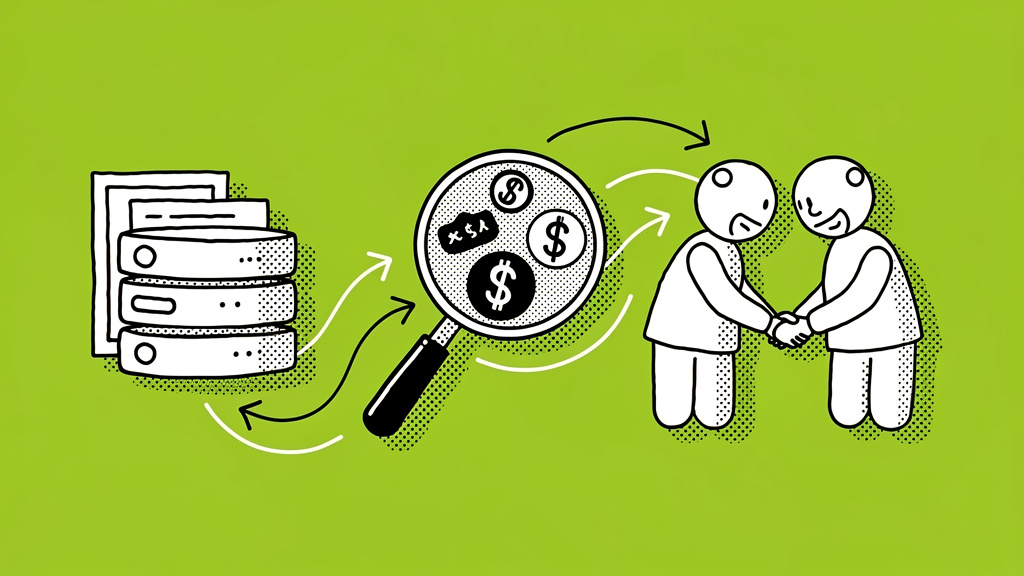
Wealth screening doesn’t get talked about enough, and honestly, that’s a shame. It sits quietly at the heart of every successful major gifts program, doing the heavy lifting between “we think this donor might be ready” and “we just closed a transformational gift.” If your team has been relying on gut instinct and spreadsheets to identify major gift prospects, we get it, but there’s a better way.
In this guide, we’re doing a proper deep dive into wealth screening: what it actually involves, how to run it well, and how to turn raw data into a first ask that feels genuine rather than transactional. By the end, you’ll have a step-by-step process that moves your major gifts program from reactive to intentional.
Why Wealth Screening Deserves a Dedicated Process
Gifts of $1,000 or more grew by roughly 4.7% year over year, while gifts under $1,000 declined by about 1.1% (Blackbaud Institute). For large organizations, the stakes climb even higher: major gifts represent 84.5% of annual revenue for large nonprofits, compared with 51.7% for smaller ones (Blackbaud Institute). So yeah, getting this right matters.
At its core, wealth screening is the process of using public and third-party data to evaluate supporters in your database for signals that they may be able, and willing, to give at a major gift level (Insightful Philanthropy). Without it, your major gift officers (MGOs) are essentially guessing. And we mean that kindly, because guessing is exhausting and expensive.
The goal isn’t to build a “rich list.” It’s to find the right fit between donor capacity, affinity, and your mission, and then build real relationships from that foundation.
Step 1: Clean Your Database Before You Screen Anything
Here’s the thing: wealth screening is only as good as the data you feed into it. Before running any external screening, invest time in your internal data hygiene. We know, not the most glamorous task, but skipping it means paying for screening results you simply can’t trust.
Critical database prep tasks:
- remove duplicate records and merge fragmented donor profiles,
- standardize formatting across names, addresses, and employment fields,
- update lapsed or incomplete contact information,
- flag deceased donors to avoid costly outreach errors,
- fill gaps with a data append service that pulls from reliable third-party sources (Carnegie Invest).
Protip: Start with your existing donor base before prospecting cold contacts. A loyal $500 annual donor who matches high wealth indicators is often a better major gift prospect than a wealthy stranger, because you already have the relationship.
Step 2: Define Your Major Gift Threshold and Screening Parameters
Every nonprofit defines “major gift” differently. Many organizations set the threshold at $5,000 or higher (Funraise), while smaller nonprofits may define it at $1,000 and larger institutions at $25,000 or more. What matters is that your definition is documented, consistent, and aligned with your revenue goals.
Once your threshold is set, configure your screening parameters with intention (Kindsight):
| Parameter | Purpose | Strategic Consideration |
|---|---|---|
| Major gift level | Sets the capacity target | Match your organizational needs and available MGO bandwidth |
| Confidence of match | Controls accuracy vs. volume | Higher confidence reduces false positives but returns fewer results |
| Capacity weighting | Prioritizes wealth vs. other factors | Decide if pure capacity or affinity matters more for your mission |
| Affinity selection | Filters by cause alignment | Select categories that match your mission area (healthcare, education, arts, etc.) |
Step 3: Choose Your Screening Approach and Data Sources
You have two primary paths here: in-house manual research or professional screening services.
In-house screening uses public records, LinkedIn, Google, and philanthropic databases. It’s cost-effective but time-intensive and requires real expertise from your development team.
Professional wealth screening platforms use machine learning and proprietary data to screen your full prospect list efficiently. Common tools in this space include Funraise, DonorSearch, iWave, WealthEngine, Blackbaud, and WealthX (RallyUp). Beyond the data itself, professional services typically offer staff training, manual verification of top prospects, automated prospect generators, and significant time savings for your team (Carnegie Invest).
External data sources these tools draw from include:
- public real estate records and property valuations,
- SEC filings and stock transaction data,
- political contribution records,
- business affiliation and corporate databases,
- foundation board memberships.
Protip: Don’t rely on a single wealth indicator. Triangulate real estate data with business affiliations, giving history, and research findings to build a complete picture of any prospect (Bonterra). One data point is a signal. Three data points are a pattern.
Step 4: Interpret the Results – Know What You’re Actually Looking At
Once screening is complete, you’ll need to understand what the indicators actually mean (Funraise). Let’s walk through the main ones.
Real estate holdings are one of the strongest signals of wealth. Property portfolio size and value reveal both liquidity and community roots.
Business affiliations, things like executive roles, board memberships, and ownership stakes, signal substantial income and network influence. Stock transactions via SEC filings reveal significant wealth, particularly for corporate executives and major shareholders.
Political contributions are interesting because they demonstrate both financial capacity and willingness to financially support causes, making them a strong proxy for philanthropic inclination. And income estimates, while never directly available, are modeled from professional position, neighborhood demographics, and other public signals.
Your AI Prompt for Wealth Screening Research
A lot of teams get stuck right here: they have screening data, but struggle to translate it into a coherent donor profile and cultivation strategy. So we figured we’d make that part easier. Here’s a prompt you can copy and paste directly into your preferred AI tool, whether that’s ChatGPT, Claude, Gemini, or Perplexity, to accelerate that translation:
I work in major gift fundraising for a nonprofit focused on [MISSION AREA]. I have completed a wealth screening for a prospect named [PROSPECT NAME OR DESCRIPTION]. Their key indicators include: [LIST WEALTH INDICATORS: e.g., real estate holdings, business role, political giving history]. Their current engagement with our organization is [ENGAGEMENT HISTORY: e.g., 3-year annual donor at $500, attended two events]. Please help me: (1) assess their major gift potential, (2) identify cultivation approach and timeline, (3) suggest a personalized value proposition connecting their background to our mission, and (4) recommend an appropriate first ask amount and format.Plus, it’s worth building on tools like Funraise that have AI built directly into the platform, keeping donor context, giving history, and prospect intelligence all in one place where you actually do the work.
Step 5: Segment Prospects by Capacity AND Propensity
Raw screening results aren’t a priority list. You have to build one. And that process is where a lot of the real strategic thinking happens.
Effective segmentation combines:
- capacity and propensity: prospects with both wealth indicators and mission affinity are your highest-priority targets,
- engagement history: existing donors have upgrade potential; past donors have reactivation potential; event attendees are cultivation-ready,
- giving capacity tier: create tiers ($5K-$25K, $25K-$100K, $100K+) and match MGO expertise accordingly,
- geographic proximity: local prospects may warrant different relationship-building approaches than distant ones.
Past giving remains the strongest predictor of future giving. As Funraise’s data confirms, if a donor has given before, they’re more likely to give again (Funraise). For prospects with giving history, your segmentation should reflect that signal prominently.
“The best major gift programs don’t just find wealthy people, they find the intersection of capacity and genuine belief in the mission. Wealth screening is how you locate that intersection at scale.”
Funraise CEO Justin Wheeler
What We See Going Wrong Every Day
Before you get to the first ask, a lot can break down. And honestly, these scenarios are painfully relatable.
“We screened our database once, three years ago, and never refreshed it.” Financial circumstances change. Businesses get sold. Markets move. A prospect screened in a bull market may have dramatically different capacity today. Best practice calls for rescreening every 12 to 18 months (Kindsight), but many teams simply never circle back.
“Our MGO spent six months cultivating a prospect who was never a real fit.” When wealth screening is skipped or poorly executed, MGOs rely on gut instinct. The result is real time and real budget spent pursuing donors who either lack capacity, lack affinity, or both.
“We knew someone was a major gift prospect, but we had no idea what to ask for.” Without layered research connecting wealth indicators to giving history and mission alignment, ask amounts are guesswork. Too low and you leave money on the table. Too high and you damage the relationship.
If any of these hit close to home, you’re not alone, and you don’t need to solve it with more spreadsheets. Funraise is built to give your team the data infrastructure to avoid these exact situations, and you can start for free with no commitment required.
Step 6: Prepare the Profile, Then Make the Ask
Before any outreach, your MGO needs a complete prospect profile: wealth indicators, affinity signals, giving history, research findings, proposed ask amount, and a personalized value proposition.
The first ask conversation should follow a clear arc:
| Phase | Key Actions |
|---|---|
| Relationship building | Share mission story; listen actively to the prospect’s values |
| Interest exploration | Ask open-ended questions about their philanthropic priorities |
| Alignment discovery | Connect their stated interests to specific programs |
| Call to action | Ask directly; offer flexible giving formats (cash, stock, DAF, recurring) |
| Stewardship planning | Define impact reporting and next communication touchpoints |
Protip: A donor’s personal connection to your mission can be as valuable as their net worth (Funraise). Always research personal touchpoints, a family member who benefited from your services, a professional history that mirrors your cause, and lead with those, not the financial data.
Measure What You Screen
Track these metrics consistently to prove and improve your screening ROI (Kindsight):
- number of new major gift prospects identified through screening,
- prospect-to-donor conversion rate among screened prospects,
- average gift size from screened vs. non-screened donors,
- time to close from initial contact to commitment,
- cost per dollar raised attributed to screening investment.
Wealth screening isn’t a one-time project. It’s ongoing infrastructure for a sustainable major gifts program. And when combined with clean data, smart segmentation, and genuine relationship-building, it’s one of the highest-ROI investments a development team can make. The path from raw data to first ask is a process, and now you have the map.
About the Author


Nonprofit Fundraising Strategy: The Psychology Frameworks Behind Sustainable Revenue
Fundraising has always been about people. Not spreadsheets, not campaign calendars, not even donor databases. At its core, it's about understanding what moves someone to open their wallet for a cause they believe in and, more importantly, what keeps them coming back. And here's the thing: behavioral science has actually done a lot of that…

Fundraising Gala Psychology: Why Black-Tie Still Outperforms in Major Donor Strategy
There's something almost counterintuitive about the fact that, in a world of viral fundraising challenges and slick crowdfunding pages, the classic black-tie gala keeps holding its ground. But here's the thing: it's not stubbornness or nostalgia keeping it alive. It's psychology. The formal charity dinner does something to donors' brains that a casual peer-to-peer run…

Best Nonprofit CRMs to Grow Your Major Gifts Pipeline
Why Your Pipeline Needs More Than a Spreadsheet Here's the sobering reality: overall donor retention hovers around 32% , and first-time donor retention falls below 25% (Virtuous). That means your major gifts pipeline is constantly leaking, and a spreadsheet simply can't tell you who's about to slip away. The good news is that nonprofits investing…